Deja vu all over again: the recurring problem of post-social policing in France

An update along the lines of our continued interest in policing “after the financial crisis”…

Le Monde reports that, come January 2010, there will be a full stop on the deployment of the unités territoriales de quartier (UTEQ), the socially-oriented policing groups developed by Nicolas Sarkozy after the banlieue riots of 2007 (and after he had virtually eliminated another socially-oriented style of policing, in 2002, known as the police de proximité).

The reason? Minister of the Interior Brice Hortefeux explains that he doesn’t have the means (“moyens”) to implement the program in light of the loss of 2,000 posts this year.  This doesn’t mean a complete loss of on-the-ground policing, however (the translation is my own):

Le rapport prône également l’élaboration d’un diagnostic “approfondi” dans chaque territoire et un “partenariat sérieux” avec les élus. Un tel scénario présenterait l’avantage de combler les trous, mais mettrait à bas la philosophie même du dispositif : être en contact régulier avec la population.

[The report also argues for a "deeper" diagnostic analysis in each territory, and a "serious partnership" with elected officials. This scenario has the advantage of filling the holes in the budget while having at its core the same philosophy: to be in regular contact with the population]

So we’re back to exactly the point we were at in 2002, when Sarozy dismissed the police de proximite as irresponsibly uneconomical even while those on the left emphasized that close contact with those being policed is essential for proper police work.

This is the “problem of a post-social police” that I wrote about in my dissertation (and which I’ve been trying to develop in an article I’ve been working on): how to devise a style of policing once the object to which its been oriented (which it helped create)–the social, as represented in a population–becomes only one in a larger array of governing objects?  This is the question police, and we as social scientists, still face and for which there are as yet no adequate answers…

Reflections on Police Violence at Berkeley

I’ve been meaning to provoke a bit more discussion regarding the confrontation between police and protesters at UC Berkeley a couple of weeks ago (although I did post something on the matter before the Nov 20th occupation), but the demands of teaching and preparing for AAA’s have been forestalling my best intentions.  On top of that, to be honest, i’m not sure what I think about it.  I’m left, mostly, with a bunch of half-articulated questions.  Aaron Bady, a graduate student in English at Berkeley has some reflections along that line over at The Chronicle of Higher Education:

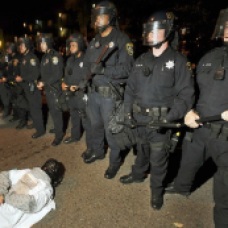
Some sort of administration response to the occupation was inevitable, of course. But why was it necessary to direct police violence against the students outside Wheeler Hall? (In fact, the university has called for an independent investigation of police actions and the university’s own decisions that resulted in the police being called onto the campus.) The more the riot police surrounded Wheeler, the more students came out to watch. But the police treated that assembly of peaceful spectators like a clear and present danger, pushing and shoving back students whose crime seemed to be their very presence on their own campus. I cannot overstate how pointless and stupid it was. The police had marked off a perimeter around the building with crime-scene tape, and I have yet to hear the allegation that a single student ever tried to cross it. But when the police began to set up metal barricades, they ordered students to move back as they smashed the barricades into the front row of students. Students who didn’t respond instantly were beaten with batons; students who touched the barricades had their hands pounded with force enough to break bones.

via Making Sense of Senseless Violence at Berkeley – The Chronicle Review – The Chronicle of Higher Education.

In response to these questions Bady makes some gestures towards both Althusser and Weber and, while I think both are important routes to traverse, I think the tone in the passage above is probably the most appropriate–simultaneously critical and perplexed.  How can we proceed and maintain its tenor?

Panels on Policing & Security at the 2009 American Anthropoligical Association Annual Meetings

I’ve compiled a list of panels and individual papers on security and policing-related issues at the upcoming AAA meetings.  You can see them below.

I’d like to give a special shout-out to the panel THE END/S OF POLICING: ETHNOGRAPHIC PERSPECTIVES ON POLICE POWER (Fri., 8:00-9:45 AM in rm 406) organized by the newest anthropolitician, William Garriott of James Madison University, also featuring myself, Michelle Stewart, Thom Chivens, Eva Harmon and Mindie Lazarus-Black of Temple University.  It should be good times.

Other than that, the following look interesting (panels are in bold):

Read more »

More on Racial Profiling Allegations in Lake County

From the Lake County News article by Elizabeth Larson:

Deputy’s association calls racial profiling allegations false; sheriff plans to release documents
Written by Elizabeth Larson
Tuesday, 17 November 2009
LAKE COUNTY – On Monday, the county’s sheriff’s deputy association called allegations of racism and racial profiling within their ranks untrue.

Following an emergency meeting held Monday morning, the Lake County Deputy Sheriff’s Association issued a statement in response to allegations made in the Bay Area media by Deputy Francisco Rivero and former department members Kip Ringen and Brian Lande.

“These false allegations are an insult to the hard working men and women of Lake County’s law enforcement,” said association President Gary Frace in the written statement.

On Monday Rivero, Ringen and Lande all stood by their comments.

Their allegations – that some of the agency’s deputies have made arrests and traffic stops based on race – were the focus of a television report last week. Rivero said the interviews they gave were filmed in May.

The claims were cause for alarm from fellow deputies.

“On behalf of the Lake County Deputy Sheriff’s Association, we adamantly deny the allegations made by Frank Rivero, Kip Ringen and Brian Lande that racism and racial profiling are rampant within the Lake County Sheriff’s Department,” Frace’s statement said.

“The Lake County Deputy Sheriff’s Association members are extremely competent and professional men and women who strive to serve the community each and every day,” the statement continued. “We are dedicated to working with the administration and the community to establish a safe and secure place for the residents and visitors of Lake County.”

The statement went on to insist that association members “do not condone any racism, racial profiling, or discrimination of any kind and will not tolerate any such action.”

It also noted that the group is consulting with its attorneys regarding the claims and will comment further in the near future pending an investigation.

In a separate action, Sheriff Rod Mitchell said he’s planning to respond to the allegations by releasing on Tuesday documents and a time line of events to show how his agency has dealt with the issues.

Mitchell said the sheriff’s office has investigated every incident of alleged racial profiling that’s been raised, with one still under investigation that’s based on the statements of Solano County defense attorney Nick Falloy.

Falloy claimed to have seen a deputy slap a Hispanic man on the back of the head during an arrest he witnessed while on a ride-along with his longtime friend, Lande. That incident, Mitchell alleged, wasn’t reported until 10 months later.

Rivero, who was surprised to hear of the deputy association’s statement and the emergency meeting, said he stands by his assertions, including that fellow deputies have called him racial epithets including “wetback.”

One fellow deputy also allegedly called Rivero – whose family came to the United States from Cuba when he was a child – a “Cuban drug dealer.”

Rivero said he’s concerned that if deputies will say those things to one of their own, they’ll do worse things to the Hispanic community at large.

Both Rivero and Lande said a few deputies also were known to make anti-gay remarks.

Rivero and Lande said they’ve seen Hispanics called “Joses.” Rivero said he’s seen Mexicans handcuffed to a deputy’s patrol car. Lande said a deputy specifically instructed him to profile Hispanics.

In addition, Rivero contended that the association meeting was called incorrectly, but Frace said, based on the bylaws, the board can call an emergency meeting at any time.

A regular meeting of the general membership is scheduled for Tuesday, Frace said. It’s 65 members include deputies, first line supervisors at the rank of sergeant and investigators with the Lake County District Attorney’s Office.

Frace said deputies are starting to second-guess themselves on the streets because of the allegations and the publicity they’re generating. That second-guessing, he said, could impact deputies’ safety.

Deputy Michael Sobieraj, who has been with the department eight years – first as a correctional officer and more recently as a deputy – said he’s never seen the kinds of racism alleged in his time there.

Sobieraj said they had a few days’ notice that the report was coming out, and that it was upsetting to watch.

Adding to the situation is that Rivero is challenging Sheriff Rod Mitchell in next year’s election, as Lake County News reported in September. His run for sheriff is aimed at changing the atmosphere, Rivero said.

“My concern is people need to be treated fairly and without prejudice,” Rivero said. “We wield a lot of power here.”

Concerns raised about how complaints were made

Rivero accused Frace and the association of making the Monday statement as a way of hurting his campaign for sheriff, claiming that the association’s board is pro-Mitchell. He also accused Frace of trying to talk him out of running.

Frace, a deputy of four years and president of the association for the past year, said he has no issue with Rivero seeking the sheriff’s job, and that he didn’t try to talk Rivero out of anything.

“What we have a problem with is Frank continually runs us into the ground, in his actions and words,” said Frace.

Rivero said he thinks only a “handful” – or as many as half a dozen – of the department’s deputies are part of the problem. “I never said it was everyone,” he explained, adding he also didn’t say the issues were “rampant.”

Ringen estimated that as much as a third of the deputies are somehow involved in unfair treatment.

Another concern for the deputies association, said Frace, is that Rivero never brought his reports about racism and racial profiling to them. Neither did Lande, nor did Ringen, who preceded Frace as the association president, Frace said.

Rivero concurred that, “officially,” he didn’t take his concerns to the association. He said he did take the matter to the sheriff personally and, when he couldn’t get anywhere, he went to the county’s administration and the Board of Supervisors, which resulted in an investigation.

Mitchell countered that Rivero never came to him about the allegations, but went to the board on March 27, several weeks after he was passed over for promotion in a sergeant’s test.

Lande, who Mitchell said gave a resignation letter dated March 20 before leaving for another law enforcement agency, joined Rivero in that complaint to the board.

That complaint included allegations by Falloy, who Lande had invited on a ride-along around Memorial Day of 2008, Lande said.

They were at a sobriety checkpoint when Falloy allegedly witnessed a deputy slap a Hispanic man in the back of the head during an arrest. Lande said he didn’t personally see the incident.

Mitchell questioned why Lande waited 10 months to make that complaint. “When did Falloy tell Lande, when did Lande tell anyone else?” he asked.

Lande admitted that the sheriff is right – it was many months later before he made the report. That’s because he was afraid of retaliation.

Falloy “wanted to say something immediately,” but Lande said he asked him not to. “I was still on probation and afraid of losing my job,” and had already made an internal affairs complaint against another deputy for safety concerns, Lande said.

Because of making that complaint, Lande was told he would never make the SWAT team.

Lande said he feels guilty because he didn’t speak up sooner.

Ringen, who was aware of deputies targeting Hispanics, said he didn’t report it to senior officials because he claimed everyone knew it was going on.

Mitchell agreed that Ringen never reported racial profiling during his time with the agency. “That was never something he ever mentioned.”

He questioned when Ringen became aware of the issues leading to the race-based allegations he’s making and when he decided to report them. “Those are the key questions,” he said, noting peace officers have a duty to report crimes and civil rights violations in a timely manner.

This past April 15, Ringen – who just turned 57 – retired after nearly 27 years with the sheriff’s office.

At the time of his retirement Ringen said he had been on administrative leave for just over four months.

While he said he hadn’t previously reported racist remarks, he said he did take information about the race-based harassment against Rivero to the sheriff’s administration on Dec. 4, 2008.

Shortly after taking that action, Ringen said he was placed on leave with internal affairs investigations leveled against him accusing him of calling a fellow sergeant a name and not following a direct order.

“I wasn’t going to continue to go through the humiliation of what Mitchell was putting me through,” said Ringen, explaining that he decided to retire. “The hunt was on.”

During the summer, Ringen – who had considered running for sheriff – decided instead to endorse Rivero. “I believe that Frank is truly a better candidate and I think he has a lot more to give the citizens of Lake County.”

He said that shortly afterward he received a call from a friend who was a district attorney’s investigator, telling him he could no longer come into the office to visit. “I’ve been basically cut off from law enforcement in Lake County,” Ringen said.

Sheriff: Investigations have taken place

Rivero is one of two people in the sheriff’s office who have filed complaints with the US Equal Employment Opportunity Commission, as Lake County News has reported.

Everyone – including Rivero – is limited on what they can say about the EEOC investigation at this point, but Rivero stated in a previous interview with Lake County News that the issues involved lack of merit-based promotions at the sheriff’s office and mistreatment of minorities by certain deputies. He indicated that he’s willing to sign a waiver to have the information released to the public.

Both Ringen and Lande said they gave statements to the EEOC on Rivero’s behalf.

County Counsel Anita Grant told Lake County News on Monday that the report the county completed earlier this year on Rivero’s complaint was sent to the EEOC, which will decide at some point if further action is taken.

While she said the report may be disclosable at some point, it can’t be released publicly while the EEOC investigation is taking place, and she has no time estimate for completion based on the EEOC being “woefully understaffed.”

Rivero also complained to the US Department of Justice. A US Attorney’s Office spokesman could not be reached for comment late Monday. Rivero said he was told by an individual within the DOJ’s Civil Rights division that the matter was being looked into.

Mitchell said his department has a long history of responding to complaints and making sure they’re appropriately investigated.

He said he went to Rivero this past May 18 for information about his allegations, and initially was put off.

Mitchell said every issue brought to his attention was investigated, including charges that deputies were targeting Hispanics for selective enforcement at driving under the influence checkpoints. There were resolutions and the resulting discipline was appropriate, he said.

One investigation remains open, said Mitchell – that regarding what Falloy said he saw during the ride-along.

Since the television broadcast there are new allegations. Mitchell said his department is exploring claims that Ringen himself made inappropriate comments.

Since the allegations have gone public, Lande said he’s been receiving hateful e-mails making personal attacks on him. “I knew that might happen.”

Lande said all he had wanted was an investigation.

“My hope is just that this will stop, not that it’s going to turn into a shouting match,” said Lande.

E-mail Elizabeth Larson at elarson@lakeconews.com . Follow Lake County News on Twitter at http://twitter.com/LakeCoNews and on Facebook at http://www.facebook.com/pages/Lake-County-News/143156775604?ref=mf .

Jonathan Simon’s provocative thoughts on the UC Strike

Over at Governing through Crime, UC Professor Jonathan Simon has some provocative words for those participating in the current 3-day UC strike:

….We ought to be united in mobilization to save higher education in California. But in choosing to make the fight a convenient and ideologically satisfying (but for the most part phony) story about privatization, down-sizing, and pernicious, corporate minded university leadership, UC’s unions and their student and faculty allies are missing a historic opportunity to engage our fellow citizens in a critical dialog about our state’s future.

That future has been mortgaged to expensive dysfunctional prisons and a bipartisan law-enforcement establishment that is committed to mass incarceration at any price. But across three decades in which that project of exiling tens of thousands of largely poor and minority Californians to a prison archipelago of mammoth proportions (which yet remains grotesquely overcrowded) has been constructed, the supporters of higher education in this state have remained silent, assuming that the incarceration of people who don’t go to college anyway is not our problem. Now the chickens have come home to roost.

via Governing through Crime: Strike Against Prisons not Education.

I think Simon is dead on here, and offers a framing that explains some of the ambivalence I’ve had about the political mobilization that’s been developing.

Most of that ambivalence, I think, revolves around my hesitation at some of the explanatory narratives that have been used as organizational and motivational tools by unions and protesters… what Simon calls the”convenient and ideologically satisfying (but for the most part phony) story about privatization, down-sizing, and pernicious, corporate minded university leadership”.

Part of what I’ve been trying to point out, both vis-a-vis the strike and in my work on French policing, is that–as both Max Weber and Walter Benjamin have shown–all politics is necessarily about violence.  This includes, especially includes, such mundane acts of governance as budgetary allocations.  As everyone from Michel Foucault to Nikolas Rose have also tried to show, these decisions are literally choices between life and death.  This is one aspect of what scholars are referring to when they talk about the biopolitical.

On the other hand, Californians are not completely comfortable with this violence and, for good reasons which I’ve also tried to explore, have tried to devise ways to limit it as much as possible.

What Jonathan’s work in Governing through Crime has shown, however, is that one of the few remaining–maybe the only remaining–domain in which the violence of governance seems legitimate to American voters is in the domain of crime control and punishment.  It therefore has become the trope through which all American governance is filtered.

What we’re left with is, on the one hand, a massively inflated, impractical and unjust incarceration system and–importantly–on the the other hand, no way of conceiving any other legitimate form of governance.

This is not a question of corporate greed versus educational egalitarianism, or even good guys versus bad guys (as much as I’d like to hate on Mark Yudof along with everyone else), but of finding a way–literally–of justifying the very real kinds of violence involved in supporting education; of including higher education into the political calculus of life and death.

Anthropoliteia at the American Anthropological Association’s 2009 Annual Meetings, pt. 1

As we get closer to this years Annual Meetings of the American Anthropological Association, I’ll be calling our attention to several of the police & security-related panels and events that will be a part of the “festivities.”

As I’ve already mentioned in the latest edition of Anthropolitieia In the News, one of these events will be a roundtable discussion with several of the authors of Cultural Anthropology’s recent “virtual issue” on security.  The roundtable, entitled “Thematizing Security,” will be held Friday December 4th at 12:15pm and will discuss the “future of critical, cultural studies of security”.  Discussion participants will include Didier Fassin, Ilana Feldman, Andrew Lakoff, and Joseph Masco

Police speak out against racial profiling in Lake County, California

Mad props to fellow Anthropolitician Brian Lande (socdeputy to ya’ll) who, along with some former colleagues of the Lake County Sheriff’s Department, spoke out on KGO-TV (that’s ABC channel 7, to y’all in the Bay Area) against the systematic racial profiling practices that have become part of the department’s habitus

You can see the full video after the break

Read more »

Anthropoliteia In the News (through 11/13/09)

To quote Timbaland, “It’s been a long time/ Shouldn’t have left you / without a dope beat to step to”

That’s right, it’s time for one more pre-AAA Annual Meetings edition of Anthropoliteia In The News.

Cultural Anthropology & Security

Thanks in part to one of our co-Anthropoliteia-ers, Michelle Stewert (along with Vivian Choi), we not along can enjoy a special “virtual issue” of the journal Cultural Anthropology on the theme of “security” but we can look forward to a discussion with several of the authors at this years Annual Meetings of the American Anthropological Association.  The event will be called “Thematizing Security” and will be held Friday December 4th at 12:15pm.  Discussion participants will include Didier Fassin, Ilana Feldman, Andrew Lakoff, and Joseph Masco

Policing the Rio Olympics

In the wake of being awarded the 2016 Summer Olympics, a violent outburst between police and drug gangs which left two dozen dead has garnered increased international scrutiny for Rio police forces, NPR reports.  Chief among the Rio police’s strategies are community-policing style attempts to integrate the police force into the poorest and most troubled areas.

Whether these strategies will actually reduce violence is unclear.  As one woman lamented,   “The violence you are seeing on TV which happened last weekend you have almost every day. If not in this favela, you have it in another favela.

“Nation’s Top Cop”

Former Boston, New York City–and now Los Angeles–police chief Bill Bratton stepped down from his position as the nation’s “top cop”  in order to work for a private security consulting agency.  Bratton has been closely associated with both the “zero tolerance” and “broken windows” philosophies of urban policing. On his last day he addressed the LAPD via radio dispatch, repeating his motto, “cops count, police matter” to the listening troops.

(Not) Famous Last Words

Claire Cameron at the New York Times wrote a haunting piece using the Texas Department of Criminal Justice’s database of death row executionee’s last words.

The Clock Is Ticking

Anthropoliteia-er Meg Stalcup writes, over at On the Assembly of Things, about the release, by the US Commission on the Prevention of WMD Proliferation and Terrorism, of “The Clock Is Ticking,” a progress report on what has happened with the recommendations made in the 2008 World at Risk publication.

Claude Levi-Strauss on police

If you haven’t heard the news yet,  anthropologist Claude Levi-Strauss passed away last week.  his passing has sparked a considerable amount of reflection and commentary–including a couple of attempts to synthesize, or, on the other hand, separate out a particular aspect of his grand corpus.

One aspect of his thought that most reviewers emphasize is his consistent critique of modernity through a complicated  anthropological lens which emphasized both a sensitivity to cultural diversity and universal human structures.  One under-remarked element of his work, however, is the way that police and policing, as ethnographic figures, functioned within his critique so as to make it possible.

I think we’re all agreed that it’s one of our shared goals here at Anthropoliteia to point out the centrality of police and policing to the anthropological project, so as a supplement to the various orbituaries and syntheses mentioned above, I thought I’d highlight a passage from Tristes Tropiques which I think illustrates my point.  Pay attention to the complicated ways in which police both illustrate and push forward his anthropological critique of modernity:

(The text is quoted, at length, after the break.  I know it’s a bit lengthy for a blog post, but there really is no way to edit the twists and turns of his prose, in that the meandering juxtapositions are often the very point.  Believe me, by the time you get to “The atmosphere thickens, everywhere” you’ll think every word has been worth it.)

Read more »

New Virtual Issue of Cultural Anthropology on “Security”

Once I get done with these midterm exams, I’ve been itching to get another edition of Anthropoliteia In the News out, but this is too exciting to wait: one of our fellow anthropoliteians, Michelle Stewart, has co-edited a special online virtual issue of Cultural Anthropology on the topic of “Security”.

Check it out at: http://culanth.org/?q=node/258

Read more »